

Contents
layout: default title: Benchmarks
nav_order: 6
Benchmarks
{: .no_toc }
Table of contents
{: .text-delta }
1. TOC
{:toc}
Test Environment
| CPU | AMD Ryzen 7 5800H — 8 cores / 16 threads |
| RAM | 40 GB DDR4 |
| OS | Ubuntu 24.04 LTS (x86_64) |
| PostgreSQL | 18.3 |
| storage_engine | 2.2.0 |
| shared_buffers | 10 GB |
| work_mem | 256 MB |
| Dataset | 1,000,000 rows |
| AM | Size |
|---|---|
| heap | 388 MB |
| colcompress (zstd, orderby=event_date) | 95 MB (4× compression) |
| rowcompress (zstd) | 106 MB |
| citus_columnar | 48 MB |
Serial — JIT off, no parallelism
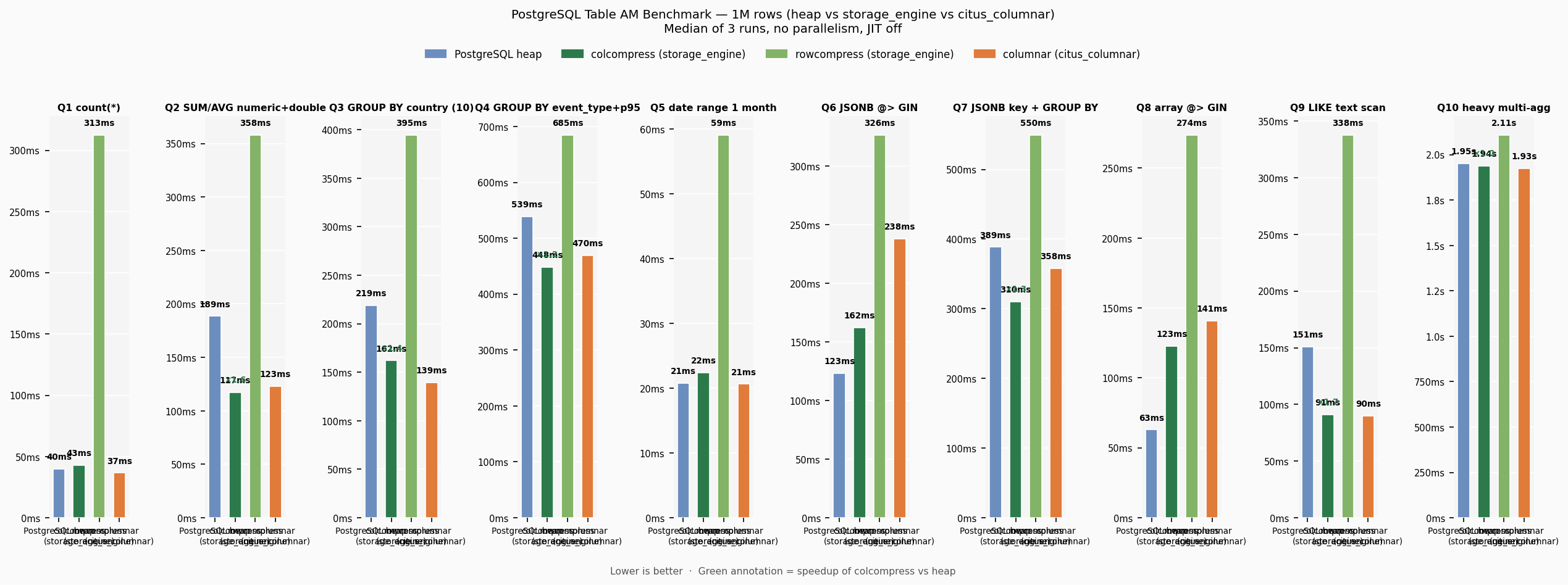
Single-core baseline: isolates raw decompression and I/O cost per AM without interference from the parallel executor or LLVM JIT.
| Query | heap | colcompress | rowcompress | citus_columnar |
|---|---|---|---|---|
Q1 COUNT(*) |
38.6 ms | 43.7 ms | 305 ms | 36.9 ms |
Q2 SUM/AVG numeric + double |
182.3 ms | 118.3 ms | 356 ms | 121.4 ms |
Q3 GROUP BY country (10 vals) |
214.4 ms | 162.3 ms | 382 ms | 141.4 ms |
Q4 GROUP BY event_type + p95 |
538.2 ms | 452.5 ms | 680 ms | 469.9 ms |
| Q5 date range 1 month | 21.1 ms | 23.5 ms | 60.0 ms | 21.1 ms |
Q6 JSONB @> GIN |
121.7 ms | 371.4 ms | 322 ms | 236.9 ms |
| Q7 JSONB key + GROUP BY | 386.2 ms | 309.0 ms | 537 ms | 354.4 ms |
Q8 array @> GIN |
61.3 ms | 329.2 ms | 272 ms | 143.8 ms |
| Q9 LIKE text scan | 147.0 ms | 88.3 ms | 333 ms | 90.3 ms |
| Q10 heavy multi-agg | 1908 ms | 1902 ms | 2067 ms | 1914 ms |
Bold = fastest for that query.
Highlights
- Q5 (date range): colcompress matches heap (23.5 ms vs 21.1 ms) because stripe pruning skips 6 of 7 stripes — data is physically sorted by
event_dateviaorderby. - Q2, Q3, Q4, Q9: colcompress wins through column projection — only the referenced columns are decompressed.
- Q6, Q8 (GIN queries): heap wins — GIN index seeks return scattered TIDs that map to random stripe reads.
Parallel — JIT on, 16 workers
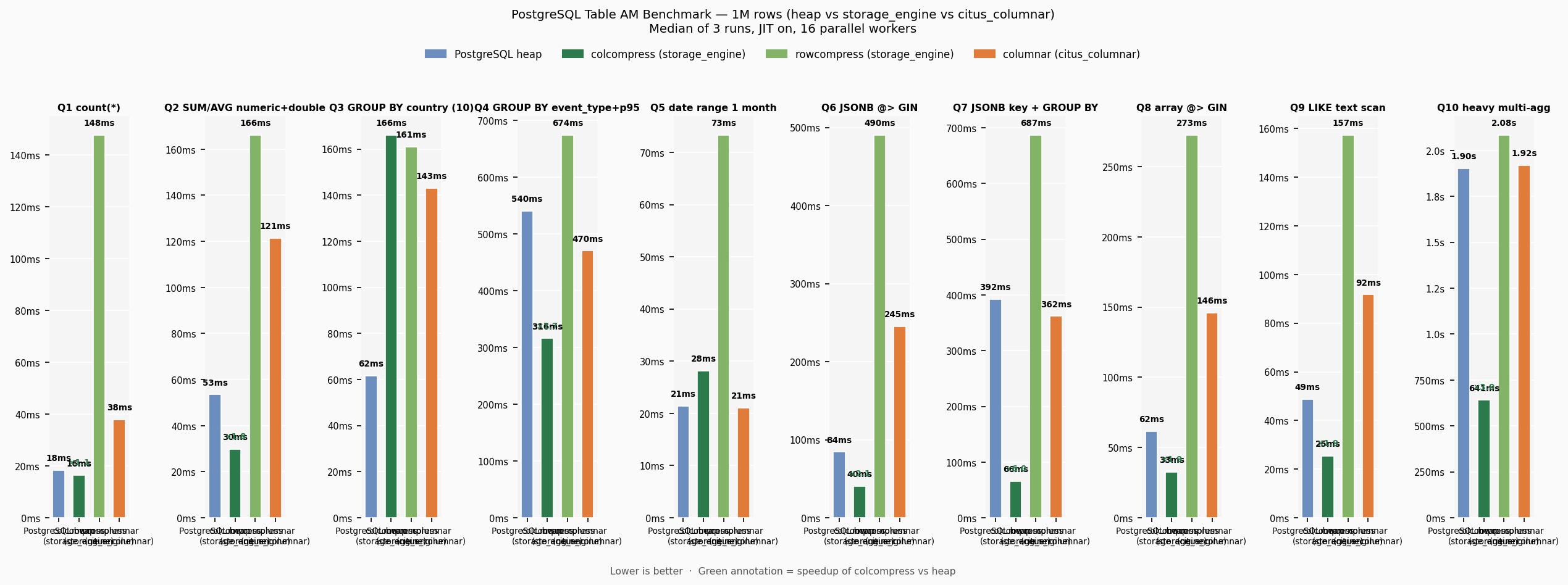
Real-world simulation: multi-core server with 16 parallel workers and LLVM JIT enabled.
| Query | heap | colcompress | rowcompress | citus_columnar |
|---|---|---|---|---|
Q1 COUNT(*) |
17.8 ms | 16.3 ms | 144 ms | 37.0 ms |
Q2 SUM/AVG numeric + double |
50.1 ms | 30.9 ms | 142 ms | 121.7 ms |
Q3 GROUP BY country (10 vals) |
57.6 ms | 171 ms | 151 ms | 138 ms |
Q4 GROUP BY event_type + p95 |
539 ms | 329 ms | 686 ms | 473 ms |
| Q5 date range 1 month | 21.2 ms | 242 ms | 69.5 ms | 21.0 ms |
Q6 JSONB @> GIN |
84.5 ms | 42.8 ms | 465 ms | 235 ms |
| Q7 JSONB key + GROUP BY | 391 ms | 87.7 ms | 692 ms | 349 ms |
Q8 array @> GIN |
61.7 ms | 33.3 ms | 275 ms | 147 ms |
| Q9 LIKE text scan | 48.7 ms | 26.8 ms | 140 ms | 91.0 ms |
| Q10 heavy multi-agg | 1951 ms | 691 ms | 2085 ms | 1958 ms |
Highlights
- Q10 (heavy multi-agg): colcompress achieves 691 ms vs 1951 ms heap — a ×2.8 speedup — through vectorized aggregate execution in each parallel worker.
- Q6, Q7, Q8 (JSONB / array): colcompress wins in parallel via column projection, reducing data each worker decompresses.
- Q5 (date range) in parallel: colcompress reads all stripes (242 ms) while heap stays at 21 ms. Stripe pruning only works in the sequential single-process path.
Key Lookup Benchmark (1M rows, serial)
Access patterns by indexed key — illustrates the different I/O characteristics of each AM.
PK Lookup (id)
| Query | heap | rowcompress | colcompress |
|---|---|---|---|
| K1: 1 id | 15.8 ms | 323 ms | 2.6 ms |
| K2: IN 10 ids | 4.6 ms | 331 ms | 92 ms |
| K3: IN 100 ids | 15.9 ms | 294 ms | 96 ms |
| K4: IN 1,000 ids | 109 ms | 300 ms | 106 ms |
colcompress wins K1 (2.6 ms) over heap (15.8 ms) because stripe pruning on
ideliminates all but one stripe before any decompression. rowcompress plateaus at ~300 ms regardless of IN-list size — all 100 batches are eventually touched.
FK Lookup (user_id, 50k distinct values, ~20 rows each)
| Query | heap | rowcompress | colcompress |
|---|---|---|---|
| K5: 1 user | 0.3 ms | 79 ms | 74 ms |
| K6: 10 users | 0.6 ms | 259 ms | 103 ms |
| K7: 100 users | 7.7 ms | 7,441 ms | 106 ms |
| K8: 1,000 users | 35 ms | 76,961 ms | 113 ms |
Heap dominates point lookups via B-tree index. rowcompress is catastrophic for scatter reads (K8: 1 min 17 s). colcompress stays flat at ~100 ms because it performs a full vectorized scan — no scatter penalty.
GROUP BY (full scan)
| Query | heap | rowcompress | colcompress |
|---|---|---|---|
| K9: GROUP BY event_type (6 vals) | 246 ms | 404 ms | 172 ms |
| K10: GROUP BY country_code (10 vals) | 236 ms | 387 ms | 123 ms |
| K11: GROUP BY user_id (50k vals, LIMIT 20) | 255 ms | 462 ms | 211 ms |
| K12: GROUP BY + date filter 1 month | 26 ms | 60 ms | 21 ms |
colcompress is fastest in all GROUP BY scenarios. K12 colcompress (21 ms) beats heap (26 ms) due to stripe pruning by
event_date.
Decision Matrix
| Workload | Best AM | Why |
|---|---|---|
| Analytics: aggregations, GROUP BY, range scans | colcompress | Column projection + vectorized execution + stripe pruning |
| Mixed HTAP: analytics + some writes | colcompress | DELETE/UPDATE supported; INSERT is fast |
| OLTP: point lookups by PK or FK | heap | B-tree index in microseconds |
| Append-only logs, audit trails | rowcompress or colcompress | rowcompress for pure append; colcompress if you need analytics on the log |
| Document storage (blobs, PDFs, XML) | colcompress + index_scan=true |
Columnar compression + point-lookup speed |
| ClickBench-style UInt64 workloads | colcompress + engine.uint8 |
Native unsigned 64-bit type with vectorized aggregates |
Reproducing
createdb bench_am
psql -d bench_am -f dist/tests/bench/setup.sql

# Serial (3 runs, take median)
bash dist/tests/bench/run.sh 3
python3 dist/tests/bench/chart.py

# Parallel
bash dist/tests/bench/run_parallel.sh 3
python3 dist/tests/bench/chart_parallel.py
Query Definitions
| Query | SQL pattern |
|---|---|
| Q1 | SELECT COUNT(*) FROM t |
| Q2 | SELECT SUM(amount), AVG(amount), SUM(price), AVG(price) FROM t |
| Q3 | SELECT country_code, COUNT(*), AVG(score) FROM t GROUP BY country_code ORDER BY COUNT(*) DESC |
| Q4 | SELECT event_type, COUNT(*), SUM(amount), AVG(duration_ms), percentile_disc(0.95) WITHIN GROUP (ORDER BY duration_ms) FROM t GROUP BY event_type |
| Q5 | SELECT event_date, COUNT(*), SUM(amount), AVG(price) FROM t WHERE event_date BETWEEN '2024-01-01' AND '2024-01-31' GROUP BY event_date ORDER BY event_date |
| Q6 | SELECT COUNT(*), AVG(amount) FROM t WHERE metadata @> '{"os":"android"}' |
| Q7 | SELECT metadata->>'campaign', COUNT(*), SUM(amount) FROM t WHERE metadata ? 'campaign' GROUP BY 1 ORDER BY 3 DESC |
| Q8 | SELECT COUNT(*), AVG(price) FROM t WHERE tags @> ARRAY['tag_5'] |
| Q9 | SELECT COUNT(*), SUM(amount) FROM t WHERE url LIKE '/page/1%' |
| Q10 | SELECT browser, is_mobile, COUNT(*), SUM(amount), AVG(amount), MIN(amount), MAX(amount), SUM(price*quantity), AVG(duration_ms), COUNT(DISTINCT user_id), SUM(CASE WHEN event_type='purchase' THEN amount END) FROM t GROUP BY browser, is_mobile |