



pg_integrity_checksums 2.9.1
- This Release
- pg_integrity_checksums 2.9.1
- Date
- Status
- Stable
- Other Releases
- Abstract
- Multi-level data integrity checksums for PostgreSQL
- Description
- pg_integrity_checksums provides checksum functions for PostgreSQL at six granularity levels (page, cell, tuple, table, index and database), each in a physical and a logical variant (cell level is logical only). Physical checksums detect storage corruption and change after VACUUM FULL, CLUSTER or REINDEX. Logical checksums depend only on data content: they exclude relation OIDs, heap TIDs and type OIDs, canonicalize enum, numeric, array, composite and range values, are endian-independent, and do not require a primary key. Logical index checksums are derived from table data and the index definition, so they work for every access method. The implementation uses FNV-1a 32-bit by default and adds generic overloads with FNV-1a 32/64-bit, CRC-32C and XXH3, supports parallel scans through the pg_integrity_checksums.workers GUC, and transparently aggregates partitioned tables and partitioned indexes. pg_integrity_checksums.strict (on by default) makes database scans fail instead of skipping relations without a usable checksum.
- Released By
- VictorNagibator
- License
- MIT
- Resources
- Special Files
- Tags
Extensions
- pg_integrity_checksums 2.9.1
- Checksum functions at page, cell, tuple, table, index and database level
Documentation
- MIGRATION
- Migrating from pg_checksums 1.x
- index
- PostgreSQL integrity checks you can run online
- installation
- Installation
- functions
- Functions and algorithms
- SECURITY
- Security Policy
- README
- Vendored third-party code
- README
- pg_integrity_checksums CLI
- CLAUDE
- CLAUDE.md
- concepts
- Concepts
- CONTRIBUTING
- Contributing
- getting-started
- Getting started
- CODE_OF_CONDUCT
- Contributor Covenant Code of Conduct
- architecture
- Architecture and internals
- upgrading
- Upgrading
- README
- README demo
- cli
- pg_integrity_checksums CLI
- testing
- Testing and releases
- pull_request_template
- pull_request_template
- requirements-docs
- requirements-docs
- operations
- Operations
- troubleshooting
- Troubleshooting
- benchmarks
- Benchmarks
README
Contents
pg_integrity_checksums - Multi-Level Data Integrity Extension for PostgreSQL








Verify that a replica, a restored backup or a migrated database holds exactly the same data as the source, without relying on physical layout.
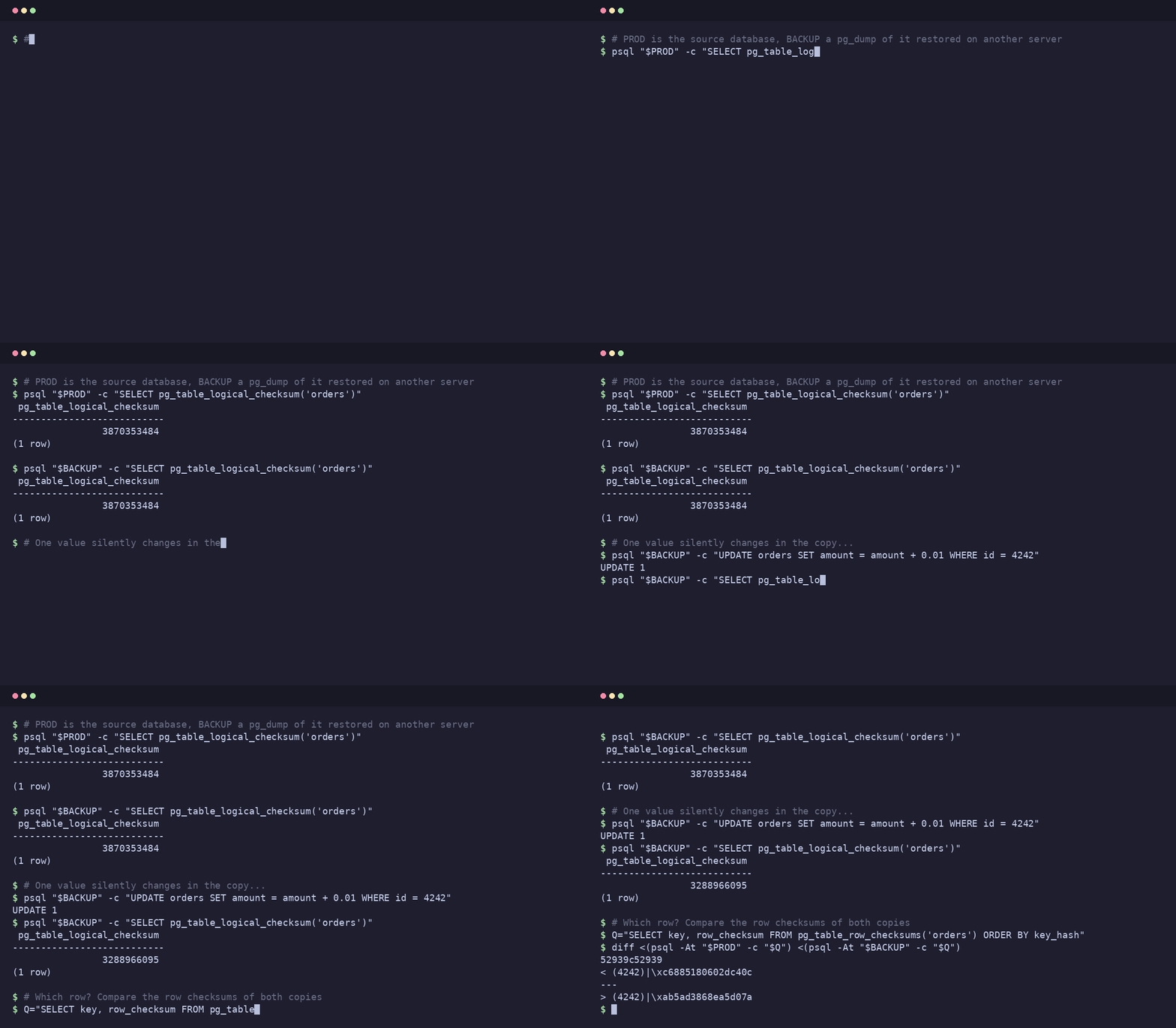
Logical checksums ignore how the data is stored: they stay the same after
pg_dump/restore, VACUUM FULL, REINDEX, a logical replica or a move to a
server with a different OS or CPU architecture. When they do not match, row
and key-bucket checksums narrow the difference down to the rows (for large
tables compare buckets first, see
Finding differing rows), and the
companion CLI automates all of it for CI. The recording is reproducible, see
demo/.
Overview
pg_integrity_checksums provides cell, tuple, table, index and database checksums. Cell checksums are logical; tuple, table, index and database checksums support both physical and logical modes.
Logical checksums are canonical across endianness, VACUUM/REINDEX/physical movement and database OIDs. Physical checksums are for on-disk corruption in one specific cluster.
The default SQL API uses FNV-1a 32-bit and returns ordinary SQL integers:
SELECT pg_table_logical_checksum('public.orders'::regclass);
SELECT pg_table_physical_checksum('public.orders'::regclass, false);
When two copies of a table differ, the logical checksum can be split by key bucket (or, on a physical standby, by block range) to find the rows that differ; see Finding differing rows.
A generic API with an explicit algorithm (FNV-1a 32/64-bit, CRC-32C or
XXH3-64) returns raw bytea digests, for a wider or faster checksum. It is described in the
function reference.
Quick start
CREATE EXTENSION pg_integrity_checksums;
SELECT pg_table_logical_checksum('public.orders'::regclass);
Install it with any of these (details):
pgxn install pg_integrity_checksums                     # PGXN
sudo apt install postgresql-16-pg-integrity-checksums   # PIGSTY APT repository
docker run -e POSTGRES_PASSWORD=secret \
  ghcr.io/victornagibator/pg_integrity_checksums:pg16   # image with the extension

git clone https://github.com/VictorNagibator/pg_integrity_checksums.git
cd pg_integrity_checksums && make && sudo make install  # from source (PGXS)
The companion CLI captures baselines and verifies a database against them,
with text, JSON and JUnit reports for CI. Download a
release binary
or use the ghcr.io/victornagibator/pg_integrity_checksums-cli image (see
CLI installation), then:
pg_integrity_checksums capture --db "$DATABASE_URL" --output baseline.json
pg_integrity_checksums verify --db "$DATABASE_URL" --baseline baseline.json
The CLI uses the 32-bit v1 baseline format by default. Add
--hash fnv64 to capture when you explicitly need a 64-bit v2 baseline.
How is this different from pg_checksums, amcheck or pg_comparator?
They answer different questions, and work well together:
| pg_integrity_checksums | pg_checksums / data_checksums |
amcheck |
pg_comparator |
|
|---|---|---|---|---|
| Answers | Do two copies hold the same data? | Is a page damaged on disk? | Are a table and its indexes structurally valid? | Which rows differ between two tables? |
| Compares two databases | yes, live or against a saved baseline | no | no | yes, both online at once |
| Unaffected by dump/restore, VACUUM FULL, CPU architecture | yes (logical mode) | — | — | yes |
| Runs on a live server | yes, in one MVCC snapshot | data_checksums on read; the pg_checksums tool needs a stopped cluster |
yes | yes |
| Finds the differing rows | yes, by key buckets, no primary key needed | — | — | yes, needs a primary key, and can sync them |
PostgreSQL’s page checksums and amcheck catch corruption inside one cluster,
but a restored backup that is missing rows, or a replica that diverged, passes
both. This extension catches that, and keeps the result as a value you can
store and compare later. See Compared with other tools.
Errors and skipped relations
Database-level checksums are strict by default (since 2.5): if a relation
cannot be checksummed (an invalid index, a corrupt page, an unlogged table on a
standby), the call fails and names the relation, instead of returning a value
that silently leaves it out. SET pg_integrity_checksums.strict = off skips
such relations with a warning; do not use that value for monitoring. See
Strict mode.
Documentation
- Documentation site
- Getting started
- Installation
- Upgrading
- Concepts
- Function reference
- Architecture
- CLI documentation
- Operations
- Benchmarks
- Testing and releases
- Troubleshooting
- CLI changelog
- Extension changelog
- Migration from 1.x
Compatibility
The 32-bit numeric SQL functions are the default and remain fully supported,
as are v1 baselines. The optional generic API adds explicit fnv32/fnv64/crc32c/xxh3
digests and v2 baselines; see Functions and algorithms
and Concepts for selection guidance.